Self-healing loop
Documentation doesn’t rot because people are lazy. It rots because nothing tells you it’s wrong.
Two return paths nobody else has. A miss becomes a work order. A resolution becomes a draft. Usage improves the asset instead of wearing it out.
How it works
The failure is the input, not the end of the story.
- 01The agent missesA question it cannot ground an answer in. Instead of a hedge, the miss is recorded with the question that caused it.
- 02Misses become a ranked clusterSimilar questions group together, ordered by how often they are asked and each carrying an estimated saving — so the top of the queue is the question you most often fail to answer.
- 03The cluster becomes workEither a draft article assembled from resolved conversations, or a capture request that arms the extension for whoever records the missing guide.
- 04Drift pauses the guideWhen a step’s selector keeps failing, the guide is flagged on Knowledge Health, a guide.drifted event fires, and by policy it stops being used as an AI answer source until it matches again.
In the product
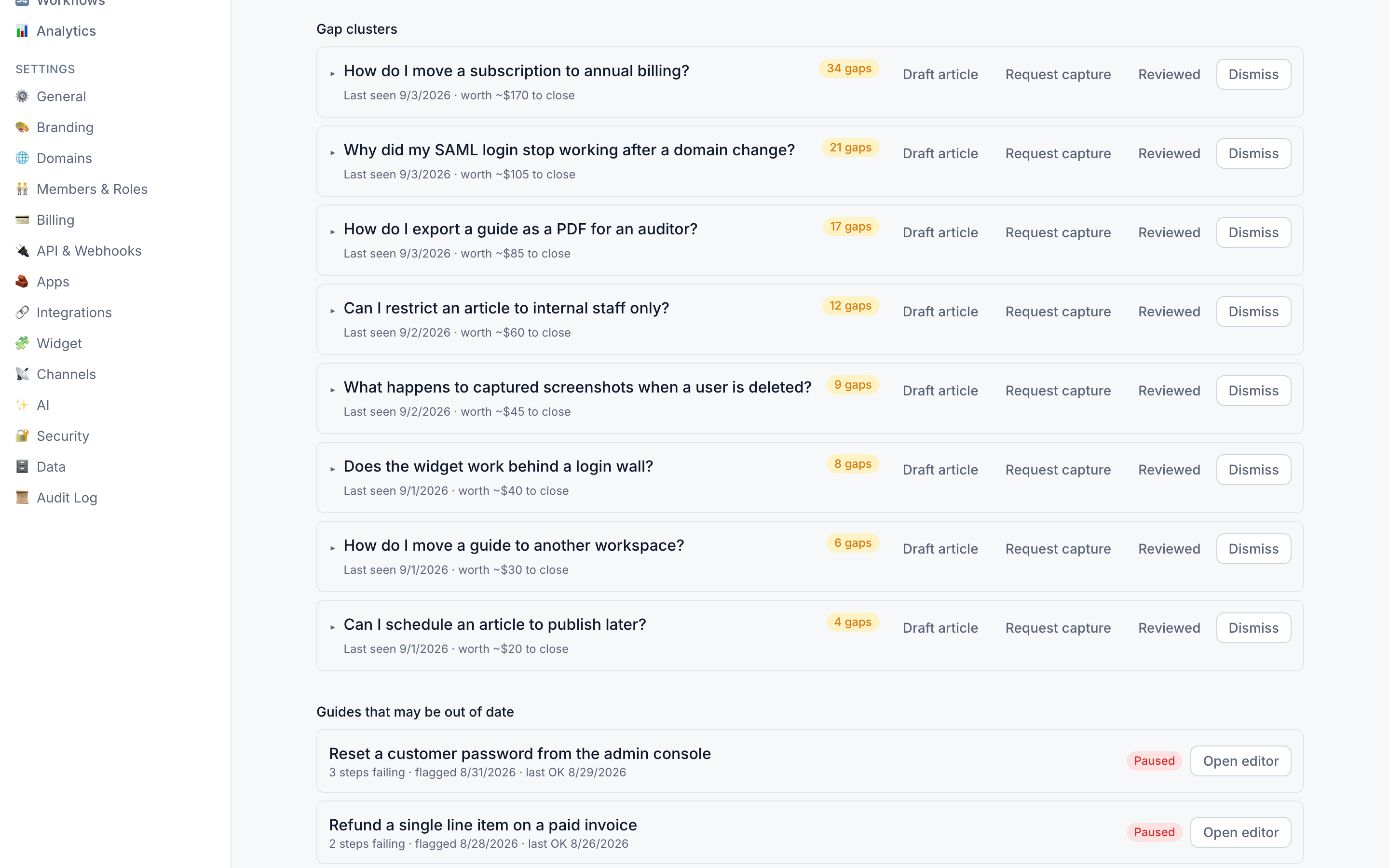
Knowledge Health
The triage queue, the estimated saving band, and the guides currently paused for selector drift. This is the screen that turns the loop from a diagram into someone’s Monday morning.
The detail
The mechanics of a knowledge base that gets better with use.
Clusters ranked by volumeOrdered by how many times the question was asked, not by what arrived most recently, with an estimated saving beside each. The saving uses one flat value per deflected conversation today — your own cost per contact is not an input yet.
Capture requests arm the extensionA one-click link arms the capture extension with the request, so recording the missing guide takes a minute rather than a meeting. It does not open the target page for you yet.
Conversation mining runs weeklyThree or more resolved conversations sharing an uncovered question become a draft assembled from the best human answers, with the originals attached for review.
Per-step health countersEvery walkthrough failure increments a counter on that specific step. Crossing the threshold flags the guide — so you learn which step broke, not just that something did.
Paused, not deletedA drifted guide stays readable for humans but stops being an AI answer source. Nothing silently serves a customer a step that no longer exists.
Deflection reported per articleDeflections, estimated value and the question volume each article covers, over any date range. The number is yours and it is checkable, which is why we are willing to show it.
Where this sits
These two dashed paths are the whole argument.
01Capture
02Knowledge
03Engage
04AI agent
Capture flows to Knowledge, to Engage, to the AI agent; a miss becomes a work order and a resolution becomes a draft, feeding back into Knowledge.
Honest limits
The loop needs traffic before it can teach you anything.
You will find this section on every feature page. If a constraint would annoy you in week two, we would rather you knew in minute one.
- Conversation mining needs conversations. A brand-new workspace has nothing to mine, and the queue will be honestly empty for a while rather than padded with suggestions.
- Drift detection only covers steps a walkthrough has actually attempted. A guide nobody runs will not self-report — coverage follows usage.
- The estimated saving is an estimate, built on one flat value per deflected conversation rather than your own cost per contact — setting that is not built yet. Treat it as a ranking aid, not a forecast.
Next
04 · AI agentIt cites its sources. Or it declines.You have been burned by a confident chatbot. The behaviour that matters is not how much it answers — it is what it does when it does not know.02 · KnowledgeOne knowledge graph. Three audiences. No copy-paste.The same source of truth serves your public help center, your signed-in customers, and your internal runbooks — with enforcement at retrieval, not at render.